
Francisco Gutierrez Rubio Will 1692
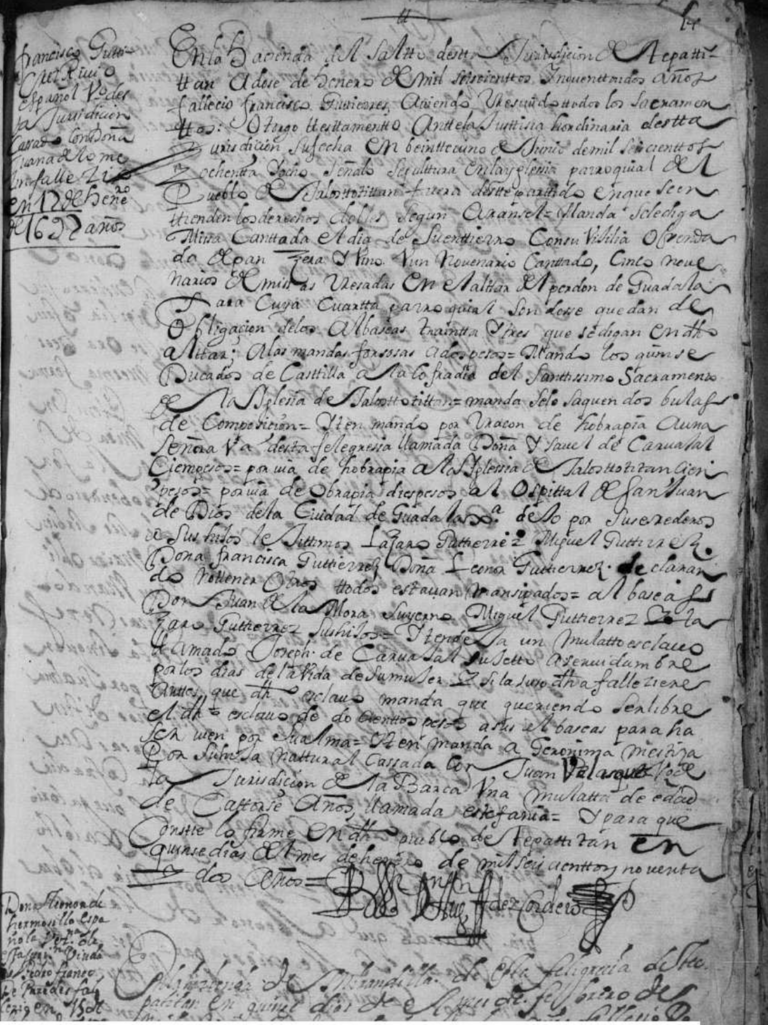
1. Francisco Gutierrez Rubio Hermosillo’s will “At the Hacienda del Salto, in the jurisdiction of Tepatitlán, on the seventh day of the month of January of the year sixteen hundred and ninety-two, passed away Francisco Gutiérrez, having received all the Holy Sacraments. He executed a last will and testament before the ordinary justice of this jurisdiction on the twenty-first of June of the year sixteen hundred and eighty-eight. He designated his burial in the parish church of this town of Tepatitlán, with burial fees according to tariff. Funeral & Masses: • He ordered that a sung Mass with vigil and offering of bread, wax, and wine be celebrated on the day of his burial. • A sung novena (novenario cantado). • Five novenas of recited Masses at the Altar of Pardon (Altar del Perdón) in Guadalajara, from which, after parish deductions, the executors are obligated to celebrate thirty-three Masses at said altar. • The customary mandatory pious bequests (mandas forzosas) at two pesos each. • Fifteen Castilian ducats to the Confraternity of the Blessed Sacrament of the Church of Tepatitlán. • Two papal bulls of composition (bulas de composición). Pious Bequests & Debts: • One hundred pesos as restitution/pious works (obrapía) to a widow lady of this parish named Doña Ysabel de Carvajal. • One hundred pesos for the church of Tepatitlán. • Ten pesos for the Hospital of San Juan de Dios in the City of Guadalajara. Heirs & Children: He named as his legitimate heirs his children: • Lázaro Gutiérrez • Miguel Gutiérrez • Doña Francisca Gutiérrez • Doña Leona [or Juana] Gutiérrez (declaring that having had others, they were already emancipated). Executors (Albaceas): • Don Juan de la Mora, his son-in-law • Miguel Gutiérrez and Lázaro Gutiérrez, his sons Clauses Regarding Enslaved Persons: • He leaves an enslaved mulatto named Joseph de Carvajal subject to service for the duration of his wife’s lifetime. If she should pass away before said slave, he mandates that if he wishes to purchase his freedom, the said slave may do so for two hundred pesos, which his executors are to use for Masses for his soul. • He leaves to Jeronima, mestiza, natural daughter, married to Juan Velázquez, resident in the jurisdiction of La Barca, an enslaved mulatto girl of fourteen years of age named Estefanía. And so that this may be on record, I signed it in the said town of Tepatitlán on the fifteenth day of the month of January of the year sixteen hundred and ninety-two.” [Signature] Bachiller Juan Fernández Cordero Top left Margin: Francisco Gutiérrez Rubio, Spaniard, resident of this jurisdiction, married to Doña Juana de Lomelín. Passed away on the 12th of January in the year 1692.
Doña Ana de Alba wife of Captain Miguel Gutiérrez de Hermosillo Burial 1704
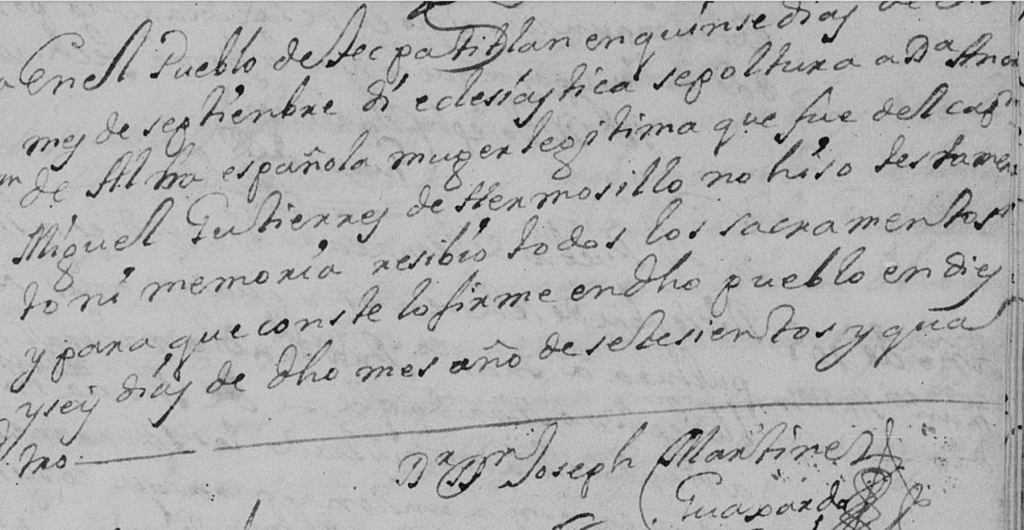
2. Doña Ana de Alba wife of Captain Miguel Gutiérrez de Hermosillo In the town of Tepatitlán, on the fifteenth day of the month of September, ecclesiastical burial [was given] to Doña Ana de Alba, Spanish woman, legitimate wife who was of Captain Miguel Gutiérrez de Hermosillo. She did not make a will nor declaration. She received all the sacraments. And so that this may be on record, I signed it in the said town on the sixteenth day of the said month, year of seventeen hundred and four. [Signed] Doctor Joseph Martínez Guajardo
Rodrigo de Carvajal & Juana Lomelín Marriage Entry 1628
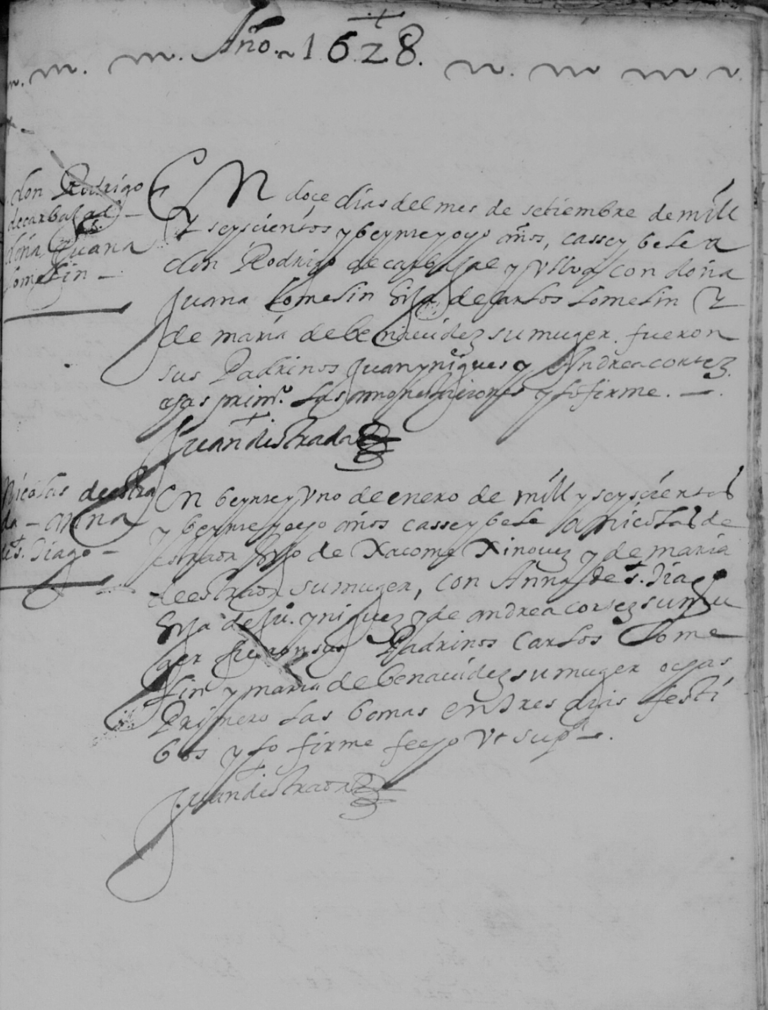
3. Header: Year 1628 (Año 1628) Top Marriage Entry (September 12, 1628) • Left Margin Note: Don Rodrigo de Carvajal [y] Doña Juana Lomelín • Main Text Translation: “On twelve days of the month of September of the year one thousand six hundred and twenty-eight, I married and veiled Don Rodrigo de Carvajal, resident [or native] of [__], to Doña Juana Lomelín, daughter of Carlos Lomelín and of María de Benavides, his wife. Their godparents [padrinos] were Juan Yñiguez and Andrea Cortez, cousins… And so that it may be on record, I signed it. [Signed] Juan de Estrada” Bottom Marriage Entry (January 21, 1628) • Left Margin Note: Nicolás de Orozco [y] Anna de Santiago • Main Text Translation: “On twenty-one [days] of January of the year one thousand six hundred and twenty-eight, I married and veiled Nicolás de Orozco, son of Jácome Ximón and of María Leed [?], his wife, to Anna de Santiago, daughter of [__] Yñiguez and of Andrea Cortez, his wife. Their godparents were Carlos Lomelín and María de Benavides, his wife. The banns were read on three holidays. And I signed it… [Signed] Juan de Estrada”
Francisco Gutierrez Rubio & Juana Lomelín Marriage Entry 1652
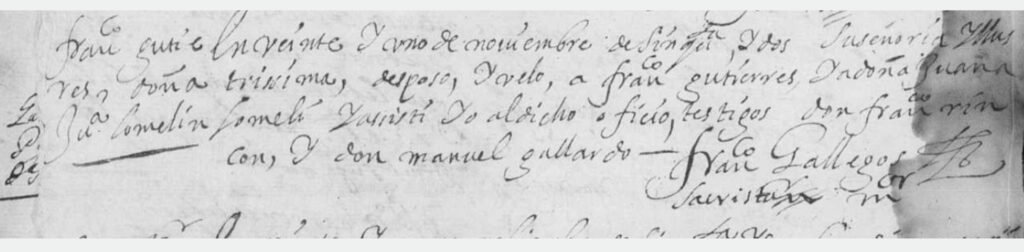
4. Left Margin: Francisco Gutiérrez [y] Doña Juana Lomelín Main Text: “On the twenty-first of November of [sixteen hundred] fifty-two, His Most Illustrious Lordship married and veiled Francisco Gutiérrez and Doña Juana Lomelí. And I assisted at the said service; witnesses: Don Francisco Rincón and Don Manuel Gallardo.” [Signed] Francisco Gallegos, Sacristán Mayor
Juana Lomelín Burial 1692
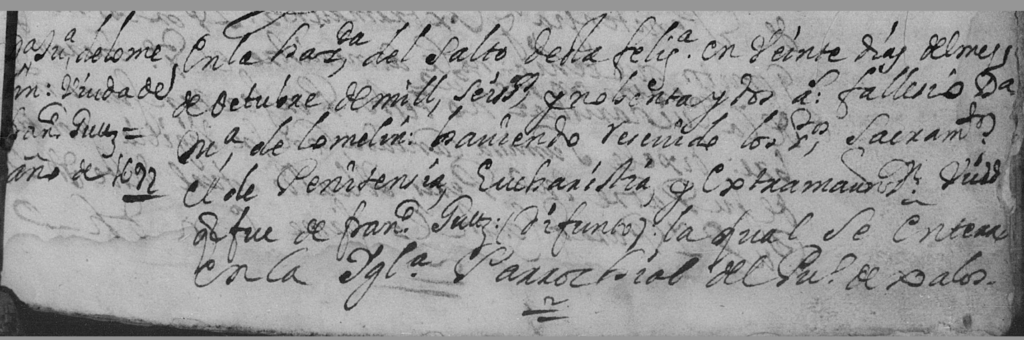
5. Left Margin: Doña Juana de Lomelín, widow of Francisco Gutiérrez. Year of 1692. Main Text: “At the Hacienda del Salto of this parish, on the twentieth day of the month of October of the year one thousand six hundred and ninety-two, died Doña Juana de Lomelín, having received the Holy Sacraments of Penance, Eucharist, and Extreme Unction; widow who was of Francisco Gutiérrez, deceased. Who was buried in the parish church of the town of…” • The words at the end of line 6: “…en la Ygl.ª Parrochial del Pu.º de Xalos” (or Talos with an archaic long X / cross). In colonial Nueva Galicia orthography: • “Pu.º” is the standard abbreviation for Pueblo. • “Xalos” is the ubiquitous 17th-century spelling for Jalostotitlán (frequently shortened in everyday speech and local records simply to Xalos / Jalos, and later formalized as San Juan de los Lagos / Jalostotitlán). Because the entry sits right at the bottom edge of the folio, the scribe cut off after writing the essential detail: that she was buried in the parish church of the town of Jalos (Jalostotitlán), which bordered Tepatitlán and shared jurisdiction over neighboring haciendas like El Salto.
Gregorio Son of Juana Lomelín & Rodrigo de Carvajal 1642
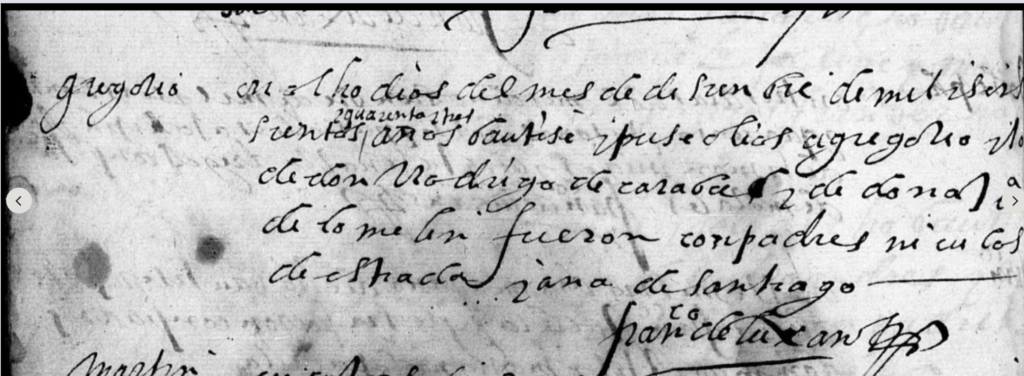
6. Son of Juana Lomelin and Rodrigo de Carvajal Left Margin: Gregorio Main Text: “On eight days of the month of December of one thousand six hundred and forty-two years, I baptized and applied holy oils to Gregorio, son of Don Rodrigo de Carvajal and of Doña Juana de Lomelín. The godparents were Nicolás de Estrada and Ana de Santiago.” [Signed] Francisco de Luxán